U.S. Data-Center Permitting Push Could Accelerate Demand for High-Speed Optics
A White House order prioritizes large AI data centers, power and networking infrastructure, potentially pulling forward demand for 400G, 800G and DCI optics.
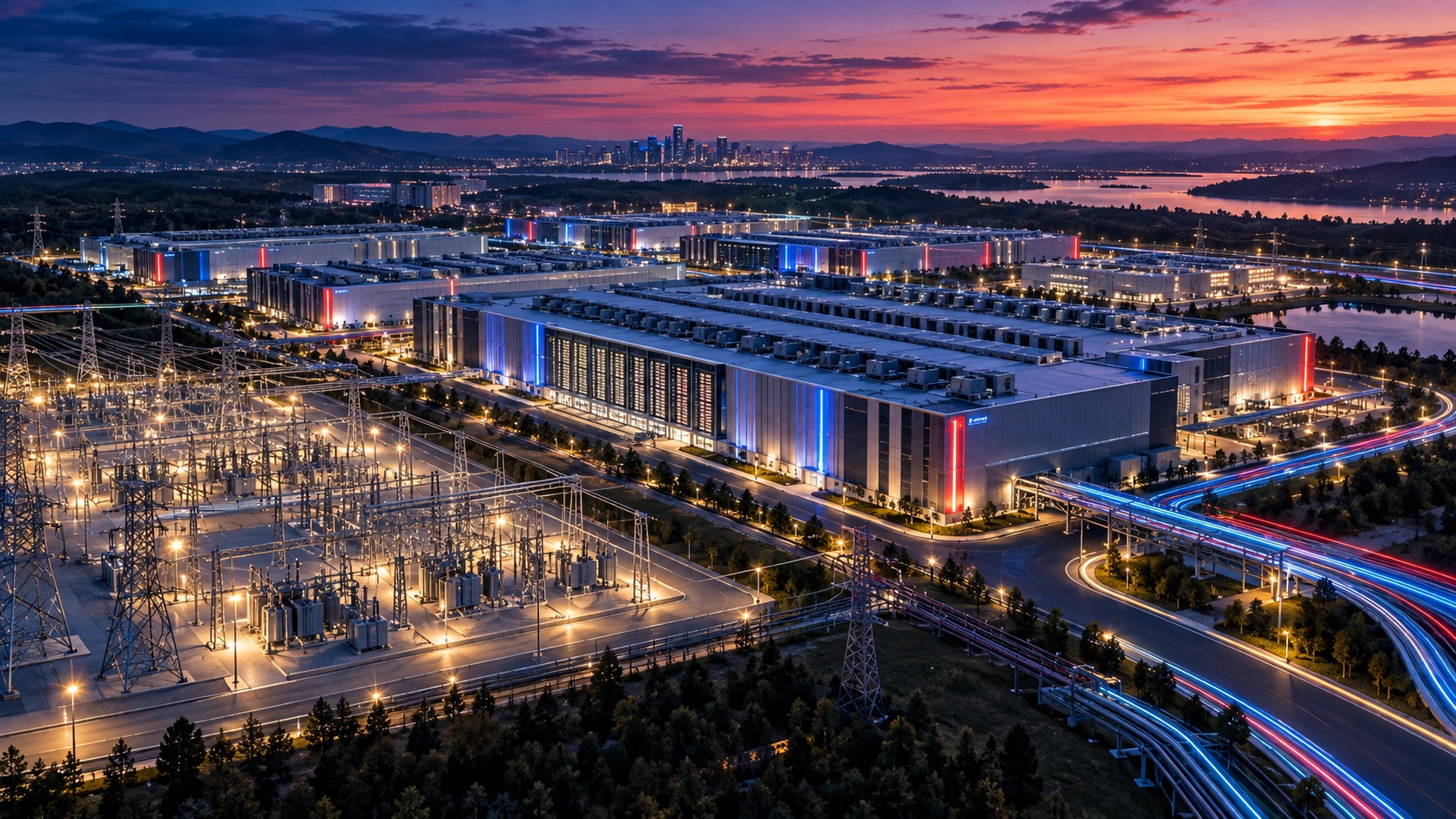
Federal policy targets large AI infrastructure
A July 2025 White House executive order defined covered AI data-center projects as facilities requiring more than 100 MW of new load and identified semiconductors, switches, routers, energy systems and storage as covered components. It directed agencies to identify financing tools and streamline environmental review for qualifying projects.
The explicit inclusion of switches and routers is important for the optical ecosystem. Large AI campuses require dense scale-out fabrics inside each building and high-capacity data-center interconnect between buildings or regions. Every expansion in accelerator count increases demand for switch ports, optical modules, fiber and testing capacity.
If permitting and power availability improve, project schedules could move forward. That would benefit 400G and 800G modules in current deployments, while creating a clearer path for 1.6T optics in next-generation clusters. The effect will vary by project because transformer supply, grid interconnection, cooling and construction remain major constraints.
Suppliers should monitor announced campus locations, power milestones and switch-platform selections rather than treating headline capital expenditure as immediate transceiver revenue.
Permitting speed is only one constraint
Faster federal review can improve schedule certainty for qualifying projects, but a data center still depends on utility interconnection, local zoning, water or cooling plans, construction labor and equipment lead times. Networking demand appears late in the building sequence yet must be designed much earlier because switch topology determines fiber counts, pathways and power distribution. Optical suppliers should therefore follow announced projects through interconnection and financing milestones rather than treating every policy-supported proposal as an immediate module order.
A large AI campus uses optics at several layers: accelerator scale-out networks inside a building, links between halls, management networks and DCI connections to other sites. These layers require different reaches and form factors, ranging from short 400G or 800G links to 1.6T fabrics and coherent transmission. Growth will not be uniform. Construction phasing, accelerator deliveries and network architecture can shift purchases between quarters. Suppliers with flexible qualification capacity, reliable lead-time information and a mix of short-reach and DCI products may be better positioned than those tied to one headline speed.
Executive actions can guide agencies, but implementation details, court challenges, budgets and future administrations may alter the outcome. Projects also face community concerns about electricity prices, land use and environmental impact. Companies should distinguish enacted rules and issued permits from political announcements. For planning, useful indicators include utility agreements, transformer orders, construction starts and switch-platform selections. The policy direction supports a larger domestic AI infrastructure pipeline, but optical demand should be forecast project by project with conservative timing and clear scenarios.
Editorial framework for decision-makers
Announcements in high-speed optics often combine a verified technical result with a forward-looking product or market claim. Those elements should be evaluated separately. A demonstration confirms that a defined configuration worked under stated conditions; it does not by itself establish volume availability, interoperability on every host, or a fixed delivery date. Network planners can use the announcement to update technology assumptions while keeping procurement gates tied to samples, compliance reports and production data. A useful review compares the proposed design with the current alternative across bandwidth, reach, power, cooling, fiber count, repair time and supply risk. It should also identify which facts come from the cited organization and which conclusions are editorial analysis. This disciplined approach makes emerging technology actionable without turning a roadmap into a purchasing guarantee.
The significance of U.S. Data-Center Permitting Push Could Accelerate Demand for High-Speed Optics becomes clearer when it is evaluated as part of a complete link rather than as an isolated component. A White House order prioritizes large AI data centers, power and networking infrastructure, potentially pulling forward demand for 400G, 800G and DCI optics. A production design must account for the host SerDes, electrical channel, optical engine, connector, fiber plant, receiver and forward-error-correction behavior as one system. Improvements in one block can be lost through extra insertion loss, retiming power or thermal constraints elsewhere. Engineering teams should therefore document the intended reach, lane configuration, modulation, fiber type and environmental limits before comparing solutions. This boundary definition also prevents a laboratory demonstration, a reference design and a qualified product from being treated as equivalent stages of maturity.
Bandwidth density is valuable only when the surrounding platform can power and cool it reliably. Module or engine power should be measured at realistic traffic loads and temperatures, including the laser source, control electronics and any host-side retimers. Designers also need to consider airflow obstruction, heat-sink pressure, neighboring-port population and the effect of a failed fan or elevated inlet temperature. A lower headline wattage may not reduce facility power if it requires additional cooling or signal conditioning. Useful comparisons therefore include watts per transported bit, ports per rack unit, cooling margin and the number of fibers or connectors required for the same aggregate capacity.
Source and editorial note
Official source: https://www.whitehouse.gov/presidential-actions/2025/07/accelerating-federal-permitting-of-data-center-infrastructure/
Goilips summarizes the official announcement and adds industry analysis. Product availability, specifications and regulations should be verified before purchasing or shipment.