Advanced Photonics Coalition Releases Five Specifications for CPO Manufacturing
A five-document portfolio gives the co-packaged optics supply chain common references for architecture, silicon photonics manufacturing, testing and multicore fiber interfaces.
What the coalition published
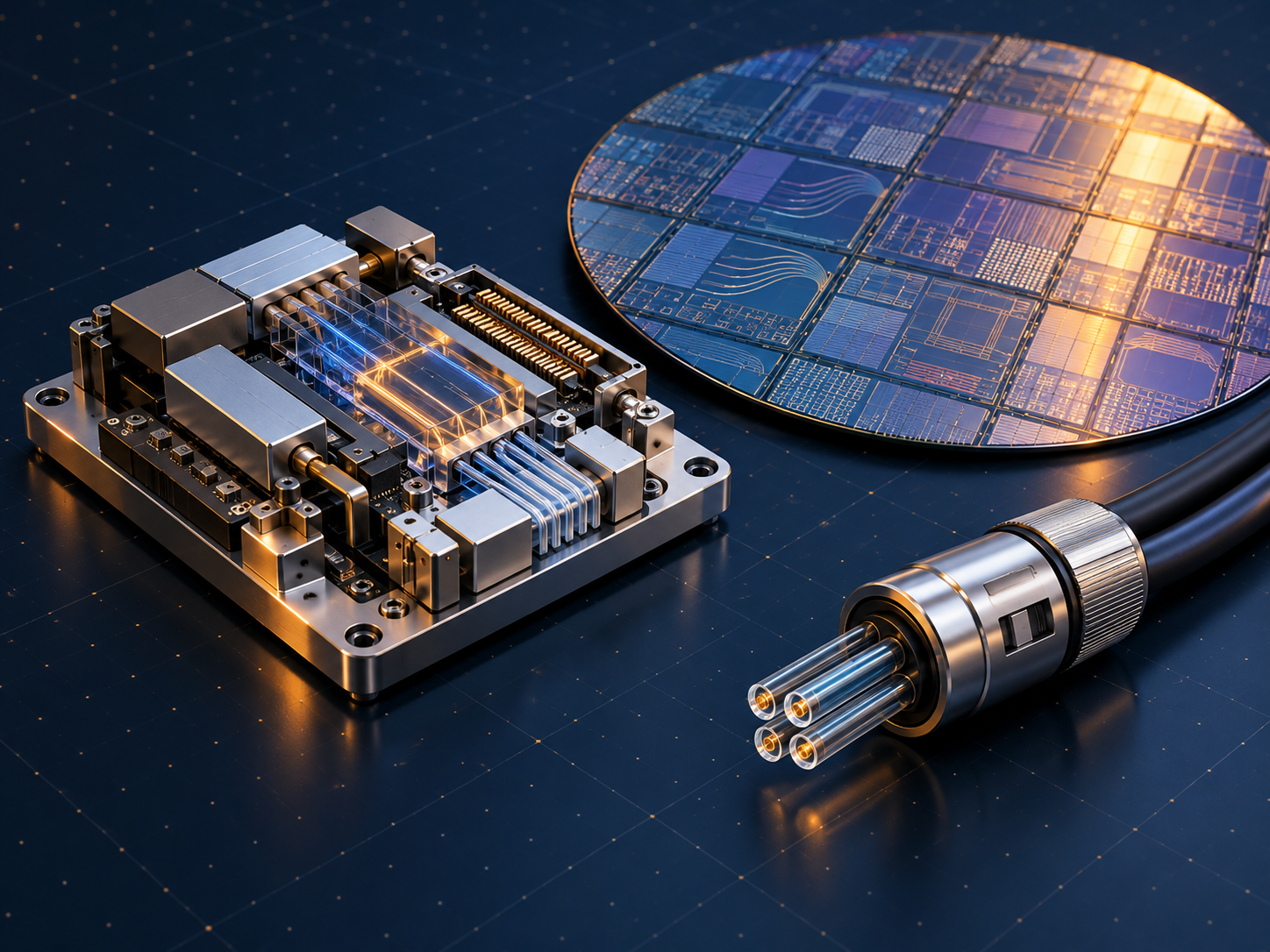
The Advanced Photonics Coalition announced a portfolio of five specifications and recommended-practice documents on October 20, 2026. The coalition said the work drew on 60 member organizations and is intended to give companies building co-packaged optics and silicon-photonics systems a shared manufacturing vocabulary. The documents cover a system-level CPO architecture overview, an informative outlook and recommended practices for CPO, recommended silicon-photonics test practices, a four-core multicore-fiber cable and connector specification, and a silicon-photonics manufacturing specification.
The breadth matters because a co-packaged optical system crosses boundaries that conventional pluggable modules often keep inside one supplier. Switch silicon, photonic integrated circuits, electronic drivers, lasers, fiber attach, packaging, cooling and test may come from different companies. If each participant chooses a different reference plane, connector geometry or test convention, engineering teams spend time translating data instead of comparing results. The portfolio attempts to define common starting points without prescribing one commercial product.
The announcement is a standards-development milestone, not proof that every implementation is interoperable or ready for volume production. Companies still need to publish which document revision they follow, which optional features they use and how their products perform under the intended operating conditions. Adoption, test correlation and multi-vendor demonstrations will determine whether the documents reduce integration work in practice.
The portfolio also arrives while the industry is evaluating several optical input/output architectures rather than converging on one mechanical design. Pluggable optics, near-packaged optics and CPO can coexist because they solve different serviceability, density and power problems. A shared reference is valuable in that environment: it lets engineering teams describe comparable boundaries without assuming that every switch, laser arrangement or fiber-management scheme must look the same. Buyers can then separate genuine interface compatibility from broader marketing claims about an architecture.
Why common manufacturing references matter
AI clusters are increasing pressure on electrical reach, front-panel density and system power. CPO moves optical conversion closer to the switch ASIC, which can shorten high-speed electrical paths, but it also changes how systems are assembled and serviced. A photonic engine may have to be attached with tight optical and electrical tolerances while operating beside a high-power processor. Yield and reliability therefore depend on process control across several suppliers rather than on one finished module alone.
Common manufacturing and test references can make handoffs more explicit. A foundry can describe wafer-level controls, an assembly house can define attach conditions, and a system company can state the measurements it expects at an agreed interface. Recommended practices also help teams separate component characterization from system qualification. That separation is useful when a failure could originate in a photonic die, laser coupling, fiber array, thermal interface or control firmware.
The multicore-fiber document addresses another integration point. Multicore fiber can carry several optical paths within one cladding and potentially reduce the physical space occupied by fiber management. Its benefit depends on compatible fan-in and fan-out assemblies, connectors, polarity rules and loss budgets. A common cable, connector and fiber-array-unit definition gives equipment and component makers a clearer basis for prototyping and sourcing, while leaving application-specific link budgets to system designers.
Implementation and commercial implications
For component vendors, the immediate opportunity is not a sudden replacement cycle but a more structured route into CPO programs. Suppliers of photonic dies, external lasers, drivers, fiber arrays, connectors, thermal materials and automated test equipment can map product data to a common set of interfaces. That may shorten early technical discussions and make second-source comparisons more disciplined. Manufacturing-service providers can also build inspection, alignment and traceability processes around the recommended practices.
System companies may use the documents to write clearer requests for information. Instead of asking whether a supplier “supports CPO,” a buyer can name the applicable architecture, connector and test document, then request evidence against specified conditions. Useful evidence includes sample size, lot identity, temperature range, optical loss, electrical performance, failure criteria and measurement uncertainty. Buyers should also confirm whether deviations are documented and whether results can be reproduced at another laboratory.
Commercial impact will depend on governance and revision control. The coalition will need feedback from implementations, and vendors will need to avoid describing partial alignment as complete compliance. Procurement teams should treat the documents as a baseline for due diligence, not a substitute for qualification. The strongest signal of progress will be repeated builds in which independent suppliers exchange parts, correlate measurements and maintain yield across production lots.
Sources and editorial note
The primary source is the coalition's October 20 announcement. The documents are listed on the APC document page. Independent coverage from IN Electronics confirms the five-document release and its high-volume manufacturing focus.
This article summarizes the published scope and explains likely supply-chain implications. Statements about lower integration cost, faster qualification or improved multi-sourcing are analytical expectations, not measured outcomes reported by the coalition. Readers evaluating a product should consult the current document revision and request implementation-specific test data.