Photon Bridge Raises €10 Million to Scale Multi-Wavelength Lasers for AI Optics
The Eindhoven company plans first samples in 2027 and volume manufacturing preparations for 2028 using an architecture that combines lower-power InP lasers.
Funding targets the laser supply layer
Photon Bridge announced a €10 million financing round on October 21 to accelerate development and qualification of multi-wavelength laser sources for AI data centers. Amadeus APEX Technology Fund and 360 Capital co-led the round, while existing investors Innovation Industries, Faber and Brabant Development Agency increased their participation. The Eindhoven company plans to deliver first samples in 2027, prepare for volume manufacturing from 2028 and expand its team.
The company is addressing a supply question created as optical links move closer to processors and switch chips. Co-packaged and near-packaged architectures can place many optical channels around high-bandwidth silicon. Every channel still needs a stable light source, and scaling the number of optical engines can multiply demand for lasers, wavelength control, packaging and fiber delivery.
Funding is evidence that investors support the program, not evidence of customer qualification or production demand. Photon Bridge has not disclosed a valuation, named volume customer or binding order in the reviewed announcement. The important milestones are working samples, verified optical performance, reliability results, foundry and packaging yield, and repeat orders after customer testing.
How the multi-laser architecture works
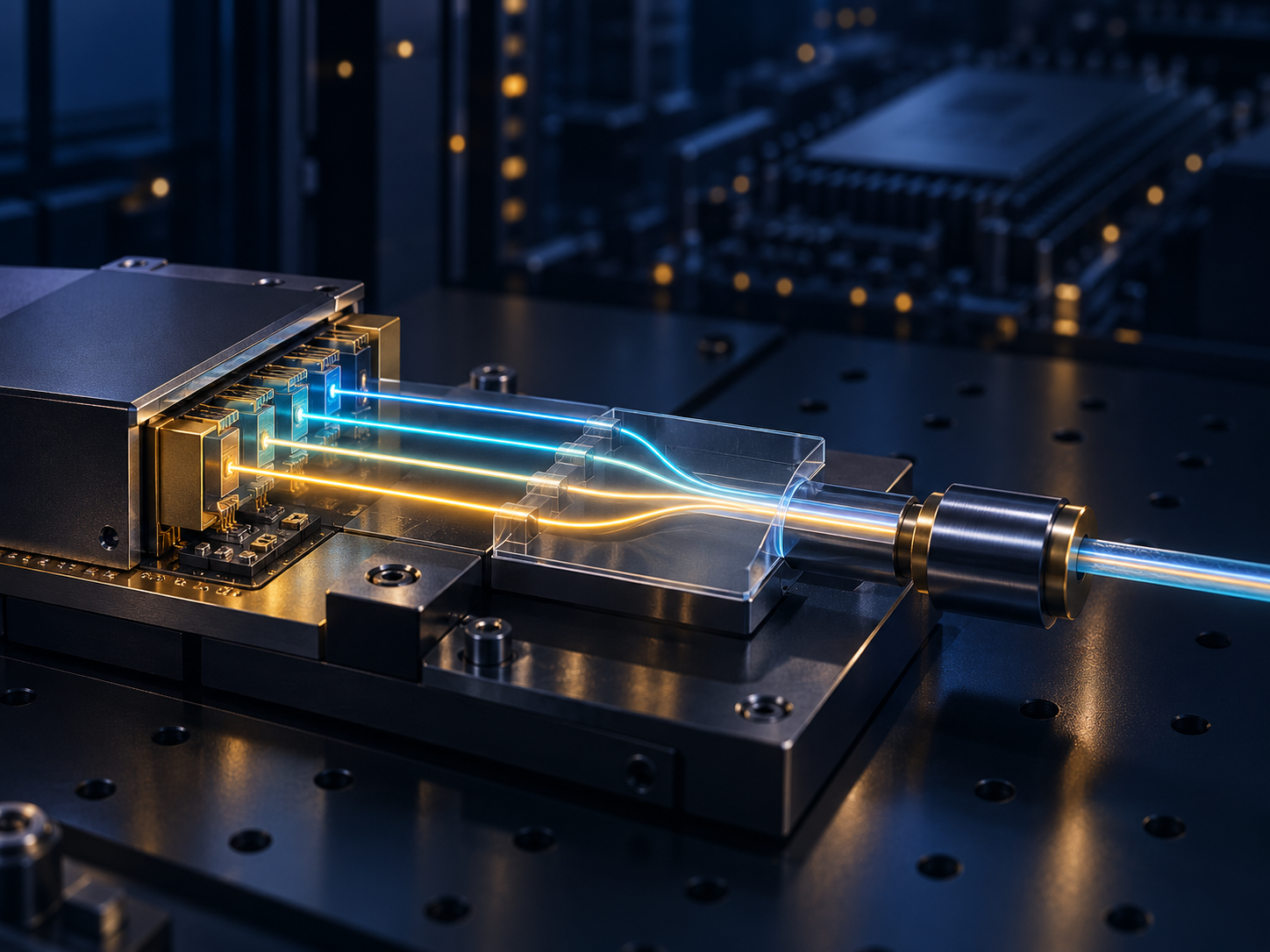
Photon Bridge proposes combining and multiplexing light from several lower-power semiconductor lasers instead of relying on a small number of increasingly powerful emitters. The company says the platform is designed for high wavelength counts and up to 40 mW of optical power per wavelength per fiber. It also intends to support manufacturing across multiple indium-phosphide foundries.
The engineering argument centers on power density and yield. A lower-power individual laser may be less sensitive to some defects and thermal stresses than one pushed to a much higher output. Combining several sources can move scaling work into the optical architecture. That choice introduces its own requirements: wavelength accuracy, channel power balance, combining loss, control electronics, redundancy, fiber coupling and thermal stabilization all affect usable output.
Multi-foundry production could improve supply resilience if processes and test methods are transferable. It is not automatic second sourcing. Wafers from different lines must meet common epitaxial, electrical and optical requirements, and packaged sources must show equivalent behavior over temperature and life. Test correlation and change control will be essential before customers treat foundries as interchangeable.
Where commercial opportunity may emerge
The most direct market is external laser sources for dense optical engines used in AI scale-up and scale-out fabrics. A source capable of feeding multiple wavelengths can support wavelength-division multiplexing and potentially simplify the number of separately packaged laser units. Opportunities extend to laser packaging, photonic combiners, fiber attach, monitoring photodiodes, control circuits, thermal hardware and automated optical test.
Customers will compare more than headline output power. They need wall-plug efficiency, relative intensity noise, linewidth where relevant, side-mode suppression, wavelength stability, lifetime and behavior after coupling losses. System designers must determine how many optical engines one source can serve and what happens after a laser or control-channel failure. Serviceability and safe optical-power delivery also matter in rack-scale systems.
Photon Bridge's roadmap leaves a deliberate gap between funding and volume. The 2027 sample phase should reveal whether the architecture meets customer link budgets and reliability targets. Preparing production in 2028 will require qualified foundries, assembly capacity, calibrated test and a controlled bill of materials. If those steps succeed, the company could participate in a laser market that grows with optical I/O even when the final module format varies.
The architecture may also serve different link formats if the optical output can be divided, monitored and delivered with acceptable loss. Pluggable modules, board-mounted engines and co-packaged optics have different requirements for fiber routing, connectorization and field replacement. A source platform that supports more than one format could broaden demand, but each configuration still needs its own safety, reliability and system qualification.
Procurement teams should ask whether quoted power is measured before or after the combiner and fiber interface, and whether all wavelengths meet the specification simultaneously. They should also request startup behavior, channel-control resolution and failure-mode data. These details reveal usable system output more clearly than the peak rating of an individual emitter and help compare the multi-laser approach with conventional external-laser modules.
An additional question is how the source is monitored during service. Per-channel telemetry can help detect gradual degradation before a link fails, but monitor accuracy, calibration drift and alarm thresholds become part of the product specification. A scalable laser platform therefore needs not only optical output but also management information that network operators can interpret consistently over its deployed lifetime.
Sources and editorial note
Round terms, technical targets and the roadmap come from Photon Bridge's official announcement. Independent coverage from Business Matters confirms the financing, investors, sample timing, production goal and stated 40 mW target. Axios Pro Rata also recorded the funding round.
Market forecasts cited by the company are not treated here as guaranteed demand. Technical advantages are presented as the company's design rationale and require independent product data when samples become available.