Cloud Optical Transport Revenue Rises 75% as Supply Constrains Deliveries
Dell’Oro reports strong Q3 2026 cloud demand; operators need to separate market growth from configuration-specific delivery and acceptance plans.
Cloud demand meets a constrained optical supply chain
Dell’Oro Group reported on November 20 that optical transport equipment revenue increased 24 percent year over year in the third quarter of 2026. Revenue from large North American cloud providers rose 75 percent. The research firm’s public announcement identifies supply availability as a constraint and says major system suppliers are taking orders for delivery in 2028. These are market estimates and an analyst’s assessment, rather than a delivery commitment covering every supplier or product.
Lightwave’s November 24 coverage independently reports the announcement and its emphasis on constrained supply. Both sources refer to the same Dell’Oro dataset; the media article is not a second measurement of the market. This distinction matters when assessing how much corroboration a widely repeated headline actually provides. The new finding concerns optical transport, so it should not be read as a growth rate for all optical modules used inside AI clusters.
The practical question raised by the announcement is how operators should connect a capacity requirement with equipment that can actually arrive in time. Goilips’ assessment is that a purchasing plan should keep three dates visible: when a service needs capacity, when a supplier can deliver a qualified configuration, and when the operator can complete installation and acceptance. Treating those dates as interchangeable would conceal the schedule risk that the report brings into focus.
Keep the market measures separate
Dell’Oro also reports strong growth in open line systems and coherent wavelength shipments, with 400G and 800G accounting for the highest wavelength volumes. These categories describe different parts of the transport market. Revenue, wavelength counts and the number of customer connections are separate measures. A higher revenue growth rate cannot by itself establish how many additional modules were installed, which routes received them, or how much unused capacity remains.
For a planning team, the first useful response is to preserve that separation in its own inventory. A route record can identify the existing line system, available spectrum, terminal equipment, traffic demand and protection arrangement. A procurement record can identify the exact configuration being quoted and its current qualification status. Linking the two records gives the team a way to explain why a specific purchase is needed without converting a broad industry percentage into a local engineering requirement.
Comparisons between suppliers should follow the same discipline. A statement about an entire equipment portfolio may not answer whether the required port, optical mode or supported software version is available. Goilips recommends requesting configuration-specific information and recording the date on which it was confirmed. This is an editorial planning recommendation, not evidence that any particular vendor has missed an order or that all components face the same shortage.
Turn a lead time into an executable network plan
The supply warning suggests a useful scenario exercise: compare the intended service date with several possible delivery schedules for the same validated design. Each scenario should show which installation and acceptance activities depend on the hardware arriving. The purpose is to expose a schedule dependency early enough for a team to discuss it with the supplier and the service owner, rather than promise an upgrade using an unverified delivery assumption.
Existing capacity can be evaluated alongside that exercise. Operators can ask whether measured traffic, reserve capacity and protection obligations permit a staged upgrade. They should document the assumptions used in that decision, including the busy-hour demand and the service behavior expected during maintenance. Goilips is not asserting that every network has spare capacity; the recommendation is to test for it using local records before making a capacity promise.
An alternative optical configuration also needs a clear acceptance boundary. If a team proposes a different terminal or operating mode, its review should establish compatibility with the actual host and line system, the route conditions and the intended management workflow. A quoted product name alone does not resolve those questions. The useful output is a configuration that can be ordered, installed, monitored and supported under a defined set of conditions.
Commercial discussions can then address the unresolved dependencies directly. Buyers can request the basis for a quoted delivery window, agreed milestones for confirmation, and the process for responding to a material change. They can also separate the first operational deployment from later expansion. This approach does not predict which vendor will have capacity; it gives the operator a more explicit record of what remains uncertain.
What the next evidence should show
The most useful follow-up would be evidence connecting market demand with delivered and accepted equipment. At an individual operator, that means confirmed delivery schedules, qualification results and service activation records. At the market level, subsequent research can show whether supply catches up and whether the growth mix changes. Those are distinct forms of evidence, and a quarterly revenue announcement should not be substituted for either a local acceptance test or a future market outcome.
For optical module suppliers, Goilips’ interpretation is to focus customer discussions on the application being served. Transport equipment purchases can involve coherent optics and line-system capacity, while an AI cluster’s internal interconnect has its own design and validation requirements. The report provides a reason to revisit delivery assumptions across a transport project. It does not establish a universal module specification, a guaranteed sales opportunity or a new deployment at a named cloud provider.
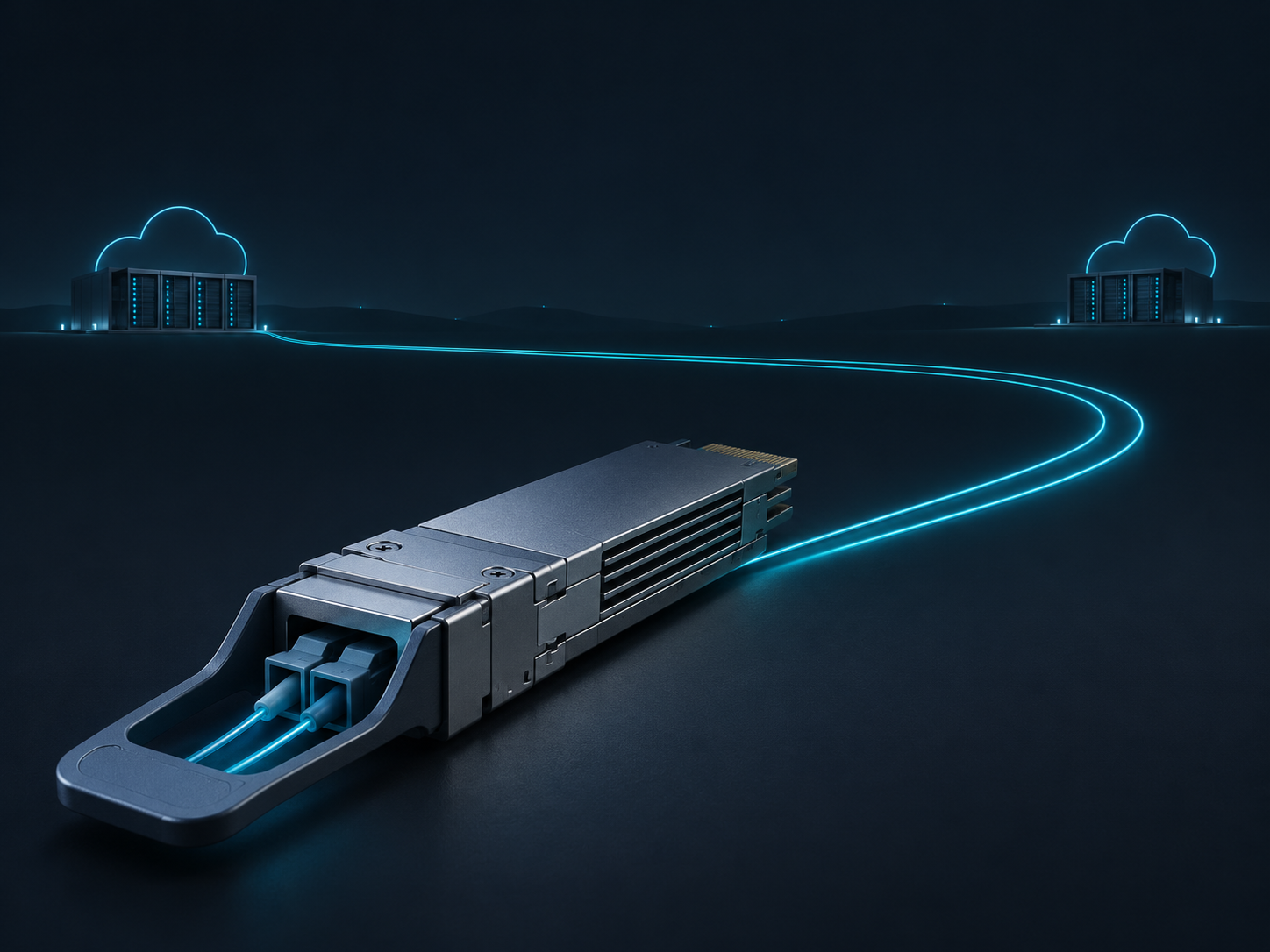
All market observations in this article are attributed to Dell’Oro’s public summary and checked against Lightwave’s reporting. The recommendations about inventory, schedules and acceptance are Goilips’ editorial analysis. The subscriber report’s underlying tables were not accessed, and no additional shipment totals or supplier delivery promises are inferred. The AI-generated cover depicts a conceptual coherent optical connection between cloud sites.