OIF Starts Seven Projects Linking Faster Optical Interfaces with Power, Security and Management
OIF’s November announcement opens development work on seven interface and management projects; it does not announce completed agreements or shipping products.
Seven development projects, with distinct technical boundaries
OIF announced on November 9 that it had initiated seven technical projects at its fourth-quarter Technical and Market Awareness and Education committees meeting, held November 2–5 in Bangkok. The official announcement identifies work spanning electrical interfaces, optical connectivity, external laser sources, module management and coherent optical security. Optical Connections News reported the same project list on November 10, providing a separately published account of the announcement. Its coverage follows the release closely and should not be treated as an independent laboratory assessment.
The distinction between starting work and completing an agreement is central to this news. OIF describes these activities as newly initiated projects. Neither the announcement nor the media account establishes commercial availability, a final compliance test suite or a common completion date for all seven. Buyers should therefore read the list as evidence of technical priorities and future interface development, rather than as a specification that can already be inserted into every procurement contract.
OIF’s current technical work directory separately lists the new activities among ongoing projects. That directory provides a useful status reference, but it is maintained by the same organization and does not constitute another independent publisher. Together, the materials support a clear conclusion: the forum is broadening work around the interfaces needed to connect increasingly demanding optical and computing systems.
Electrical lanes and bidirectional optics advance on separate tracks
One project will define energy-efficient half-retimed electrical interface requirements at 448 Gbps per lane under the EEI-448G Retimed Transmit Linear Receive initiative. OIF positions it as complementary to its expanding CEI-448G portfolio. The rate describes an electrical lane in this project; it is not an announced optical module throughput, a measured system benchmark or a guarantee of power savings in a particular host.
A second project concerns bidirectional O-band single-mode fiber connectivity at 200 Gbps per lane for AI scale-up applications. This is a different interface domain from the 448G electrical work. The two figures should not be combined into a single product specification. The announcement identifies an intended optical interface and application, while leaving the eventual implementation agreement to the development process.
Goilips’ engineering interpretation is that roadmap reviews should track the host electrical interface and optical link independently. Teams evaluating a future architecture can record the intended topology, interface boundary and evidence required at each stage. Keeping those records separate would help prevent a demonstration in one domain from being mistaken for qualification of the complete connection. This is an evaluation approach, not a claim that OIF has mandated a particular network architecture.
External lasers, management and security complete the list
Two initiatives address external laser sources. ELSFP IA 3.0 begins the next revision of the External Laser Small Form Factor Pluggable agreement. A separate Type-3 elongated ELSFP project addresses support for Electrical Power Class 8 High Power Mode at 40 W. That value is a power-class requirement under development for an external laser variant. It is not a statement of optical output power, a universal module consumption figure or a requirement for all transceivers.
The management work includes an implementation agreement for managing MACsec functionality inside pluggable modules. Another project will develop a USB-based Management Communication Interface for the Common Management Interface Specification, known as CMIS. These initiatives concern how functions are managed and how management communication is carried. The announcement does not say that existing modules automatically gain either capability through a firmware update.
The seventh activity, ZRsec using FlexOsec for coherent optical interfaces, seeks a common implementation technique for layer-one encryption in ZR applications. Its scope should remain distinct from the MACsec management project. The public announcement does not establish that the two security approaches are interchangeable, nor does it announce a completed end-to-end security architecture for an operator.
Taken together, the list makes supply power, management access and security part of the same development agenda as interface speed. That connection is an editorial reading of the project mix. It does not quantify the cost, energy efficiency or deployment benefit of a future implementation, and the sources provide no comparable measurements that would support such a calculation.
What equipment teams can verify next
For Goilips, the practical next step is to attach evidence gates to each relevant project. A roadmap entry can identify the current public scope, the responsible interface and the document revision being considered. Before a feature becomes a purchasing requirement, the review should establish whether an approved agreement exists and whether the proposed supplier actually implements the needed functions. Announced participation alone would not answer those questions.
Qualification planning can then connect the selected module to its host, power delivery and management environment. Where an external laser source is involved, engineers could request the applicable mechanical and electrical requirements rather than inferring them from a family name. Where security is involved, the review could specify the intended protection boundary and how the function will be configured and supported. These are Goilips recommendations for evaluation, not reported OIF test procedures.
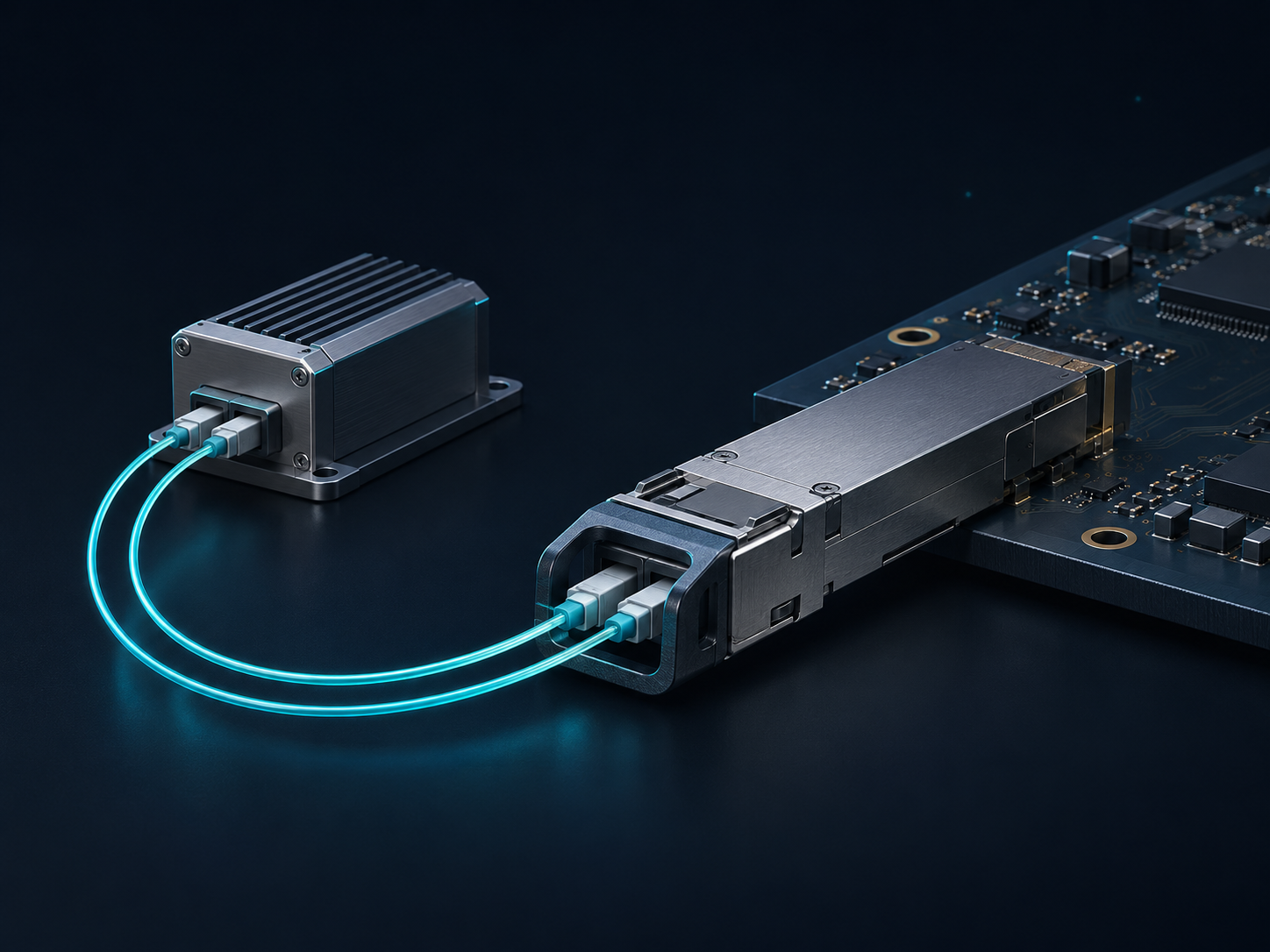
The strongest follow-up signals would be approved documents, defined compliance requirements and documented interoperability results for named implementations. Until then, the seven starts are a useful guide to where industry coordination is expanding. The news is the launch of development work, and its significance lies in the breadth of that work. The AI-generated cover is a conceptual illustration of generic optical and external laser modules; it does not depict a certified OIF product.