1.6T Silicon-Photonics Module Uses a 3nm DSP to Cut Power
Coherent’s 1.6T DR8 demonstration combines 200G electrical and optical lanes with a 3nm DSP, targeting more than 20% lower DSP power.
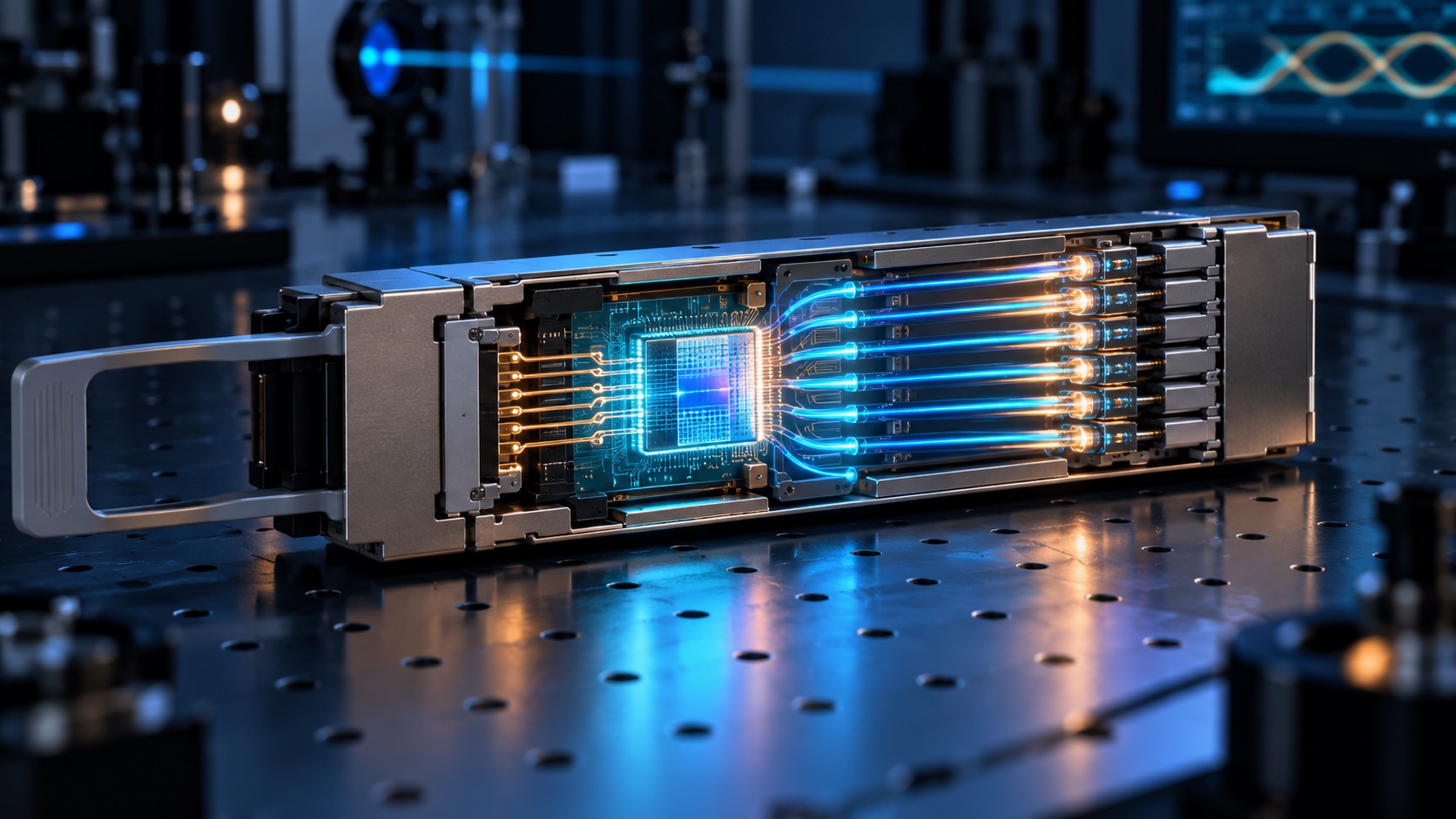
A 200G-per-lane 1.6T design
Coherent demonstrated a silicon-photonics 1.6T-DR8 transceiver using Marvell’s Ara 3nm PAM4 optical DSP. The module uses 200 Gb/s electrical and optical interfaces, representing the industry transition from 100G lanes in early 800G products to 200G lanes for 1.6T.
Power is now a first-order specification
The companies target more than a 20% reduction in DSP power compared with the previous generation. That matters because a high-density switch may carry dozens of modules; every watt at the module faceplate adds electrical cost and cooling load.
What buyers should verify
Process-node claims describe one component, not total module power. A procurement specification should request maximum module power, case-temperature range, airflow assumptions, CMIS behavior, FEC requirements and measured host interoperability.
Silicon photonics can improve integration and manufacturing scale, but laser architecture, fiber attach, DSP firmware and thermal design still determine real-world reliability. Qualification should therefore cover the complete module rather than the photonic chip alone.
How silicon photonics and the DSP divide the work
Silicon photonics integrates modulators, waveguides and other optical functions on a semiconductor platform, while the DSP handles PAM4 encoding, equalization, clock recovery and error-related functions. Improving only one side is insufficient. A more efficient DSP can lower electrical power, but optical coupling loss, laser efficiency and package temperature still determine the module's total consumption. Conversely, a capable optical engine cannot compensate for a poor host channel. The 1.6T design is therefore a co-optimization problem spanning the switch ASIC, board, connector, DSP, photonic die, laser and fiber interface.
What the power claim means in a rack
A percentage reduction in DSP power becomes meaningful when multiplied across dozens of ports and thousands of switches. Lower module power can reduce fan speed, ease front-panel hot spots and preserve rack capacity for compute. Yet buyers should ask whether a quoted improvement applies to the DSP alone or the complete module, and under which traffic, temperature and FEC conditions it was measured. They should also compare typical and worst-case values. For a production design, thermal headroom during a fan fault or high inlet temperature can matter more than a favorable room-temperature demonstration.
Qualification path toward volume deployment
Before large orders, operators should validate transmitter quality, receiver sensitivity, pre-FEC error rate, latency, DOM accuracy and firmware behavior on the intended host. Aging and temperature cycling help reveal assembly or laser-coupling weaknesses that a short bench test may miss. Supply-chain review should cover the DSP, photonic wafer, external laser and packaging capacity because a module can be constrained by any one of them. If 200G-per-lane ecosystems achieve stable yield and interoperability, 1.6T DR8 can become a practical building block for the next generation of AI scale-out fabrics.
Editorial framework for decision-makers
Announcements in high-speed optics often combine a verified technical result with a forward-looking product or market claim. Those elements should be evaluated separately. A demonstration confirms that a defined configuration worked under stated conditions; it does not by itself establish volume availability, interoperability on every host, or a fixed delivery date. Network planners can use the announcement to update technology assumptions while keeping procurement gates tied to samples, compliance reports and production data. A useful review compares the proposed design with the current alternative across bandwidth, reach, power, cooling, fiber count, repair time and supply risk. It should also identify which facts come from the cited organization and which conclusions are editorial analysis. This disciplined approach makes emerging technology actionable without turning a roadmap into a purchasing guarantee.
Source and editorial note
Official source: https://www.coherent.com/news/press-releases/silicon-photonics-based-transceiver-modules
Goilips summarizes the official announcement and adds industry analysis. Product availability, specifications and regulations should be verified before purchasing or shipment.