High-density fronthaul links between 5G base station AAUs (Active Antenna Units) and DUs (Distributed Units).
With deeper 5G coverage and the evolution toward 5G-Advanced (5.5G), antenna channel counts such as Massive MIMO 64T64R and radio bandwidth continue to increase sharply. This creates major pressure on fronthaul bandwidth and fiber resources in C-RAN architectures.
Traditional fronthaul links use duplex transmission, where each link consumes two fiber cores: one for transmit and one for receive. In urban areas or long-span deployment scenarios where ducts and fiber resources are scarce, laying new optical cable is expensive and slow.
This solution uses Goilips 25G/50G industrial-grade single-fiber bidirectional (BiDi) optical modules. With WDM technology, transmit and receive signals share one single-mode fiber, reducing physical fiber usage by 50%. The modules support industrial wide-temperature operation from -40°C to +85°C, making them suitable for harsh outdoor 5G environments.
Solves severe duct and fiber shortage issues between centralized BBU/DU rooms and distributed remote AAU sites.
Supports smooth upgrades from 25G eCPRI to 50G eCPRI/CPRI interfaces for high-bandwidth antenna signal transport.
Suitable for tower-top, pole-mounted, outdoor cabinet, RRU/AAU-side, and other non-air-conditioned scenarios with large temperature swings.
Between AAU and DU sites, Goilips BiDi modules are directly plugged into both ends to deliver full-duplex transmission over a single fiber core, removing the need for intermediate passive WDM shelves.
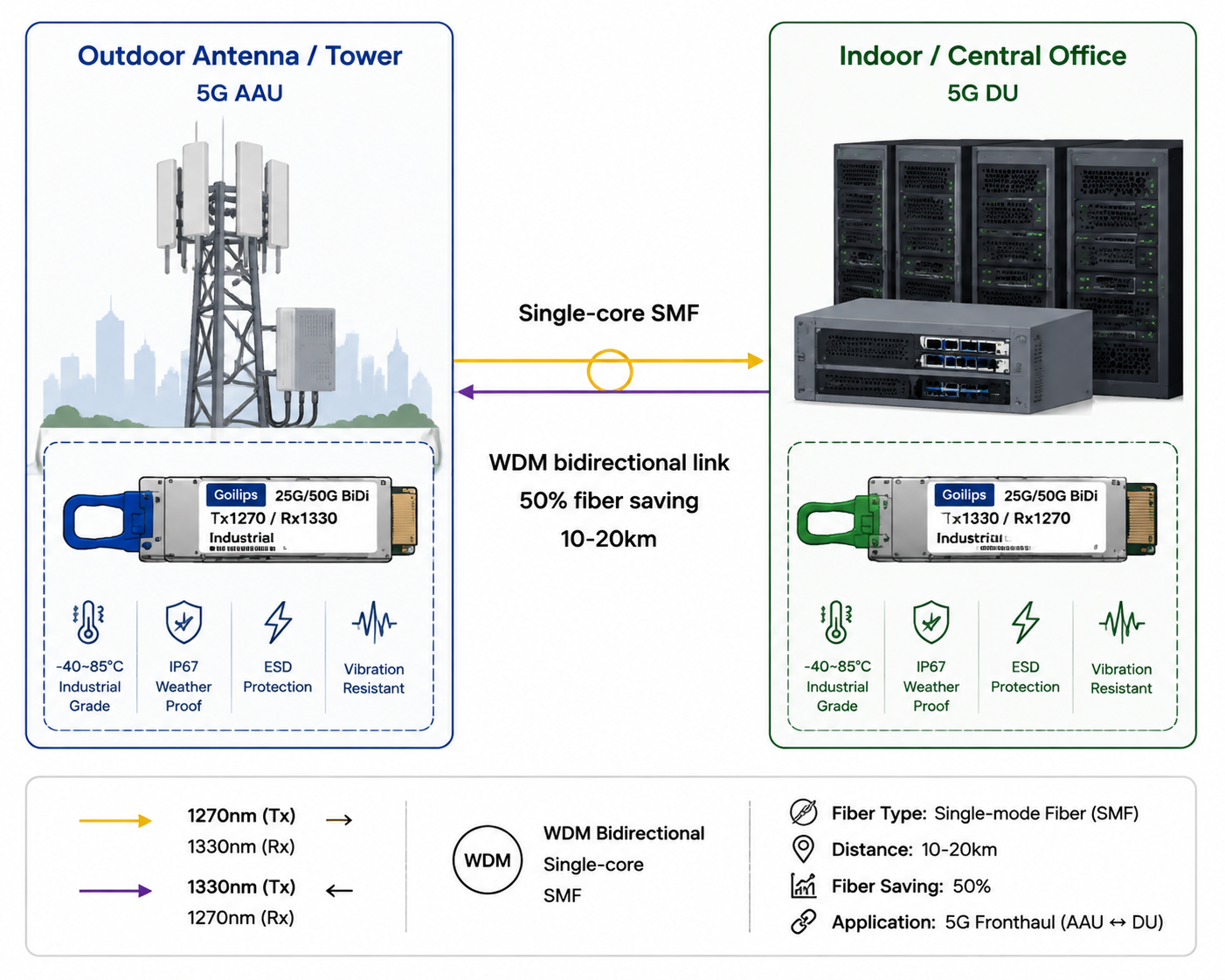
Core Deployment:Typical wavelength pairs include Tx1270nm/Rx1330nm and Tx1330nm/Rx1270nm, supporting 10km or 20km reach.
Advantage:Matches eCPRI and CPRI 10 interfaces for existing 5G macro base-station fronthaul links.
Core Deployment:Uses 1270nm/1330nm PAM4 single-fiber transmission over 10km or 20km links.
Advantage:Supports eCPRI 50G and IEEE 802.3cd requirements for 5.5G ultra-high-bandwidth, high-density channel access.
Core Deployment:Supports -40°C to +85°C operating temperature with high-reliability TEC-controlled lasers or wide-temperature tolerant chips.
Advantage:Maintains stable service under direct sunlight, severe cold, snow, and other outdoor conditions without packet loss or rate downgrade.
Core Deployment:Optimized for 5G eCPRI with low-latency transmission, SyncE, IEEE 1588v2 PTP, sensitive receivers, and FEC support.
Advantage:Meets strict 5G phase synchronization requirements and preserves link margin under fiber aging, connector loss, or micro-bending attenuation.
An AAU-DU link that previously required two fiber cores now uses only one, directly doubling the capacity of existing fiber plant and avoiding large new cable construction costs.
Existing fiber architecture can be reused. Operators only need to replace modules at both ends and connect single-fiber jumpers, significantly shortening 5G site activation time.
By cutting fiber splice points and connector count by half, the solution reduces maintenance incidents caused by connector contamination, splice loss, and physical fiber breaks.
Simplify your network deployment and reduce complexity. Connect with our engineers for a solution design tailored to your project.
Expert customer service on call, 5x24 phone support.
For general questions, email us anytime.
Our live agent is ready to chat and help in real time.