Building highly available, redundant ring networks between core-layer and aggregation-layer devices on campus networks.
Modern smart campuses are rapidly digitizing teaching, research, and administration. Campus networks now support live online classes, research big-data transfer, smart security monitoring, campus card systems, and other mission-critical services.
If a core backbone link suffers a single-point failure or is interrupted by lightning, surge events, or external fiber damage, teaching and management systems across the campus can be affected. Traditional campus networks built with single-chain or tree topologies lack sufficient physical redundancy and disaster resistance.
This solution uses Goilips 40G/100G ER4 long-life single-mode optical modules with ERPS (G.8032) / RRPP dual-active ring protection protocols to build highly available core backbone networks for multi-campus smart campuses, supporting 40km spans, hardware-level lightning and surge protection, and 50ms self-healing.
For long-distance 10G/100G core links between main campuses, new campuses, medical campuses, and research parks across several kilometers to tens of kilometers.
Connects teaching buildings, libraries, laboratories, data centers, and dormitory aggregation nodes with millisecond-level redundancy protection.
Ensures high-throughput, smooth, and uninterrupted transmission of thousands of HD/Ultra-HD security camera streams to the data center.
Between the main campus core equipment room and branch-campus or building aggregation rooms, dual-fiber bidirectional long-reach modules build a non-blocking closed-loop topology. Active-active or hot-standby links provide load sharing and automatic failover.
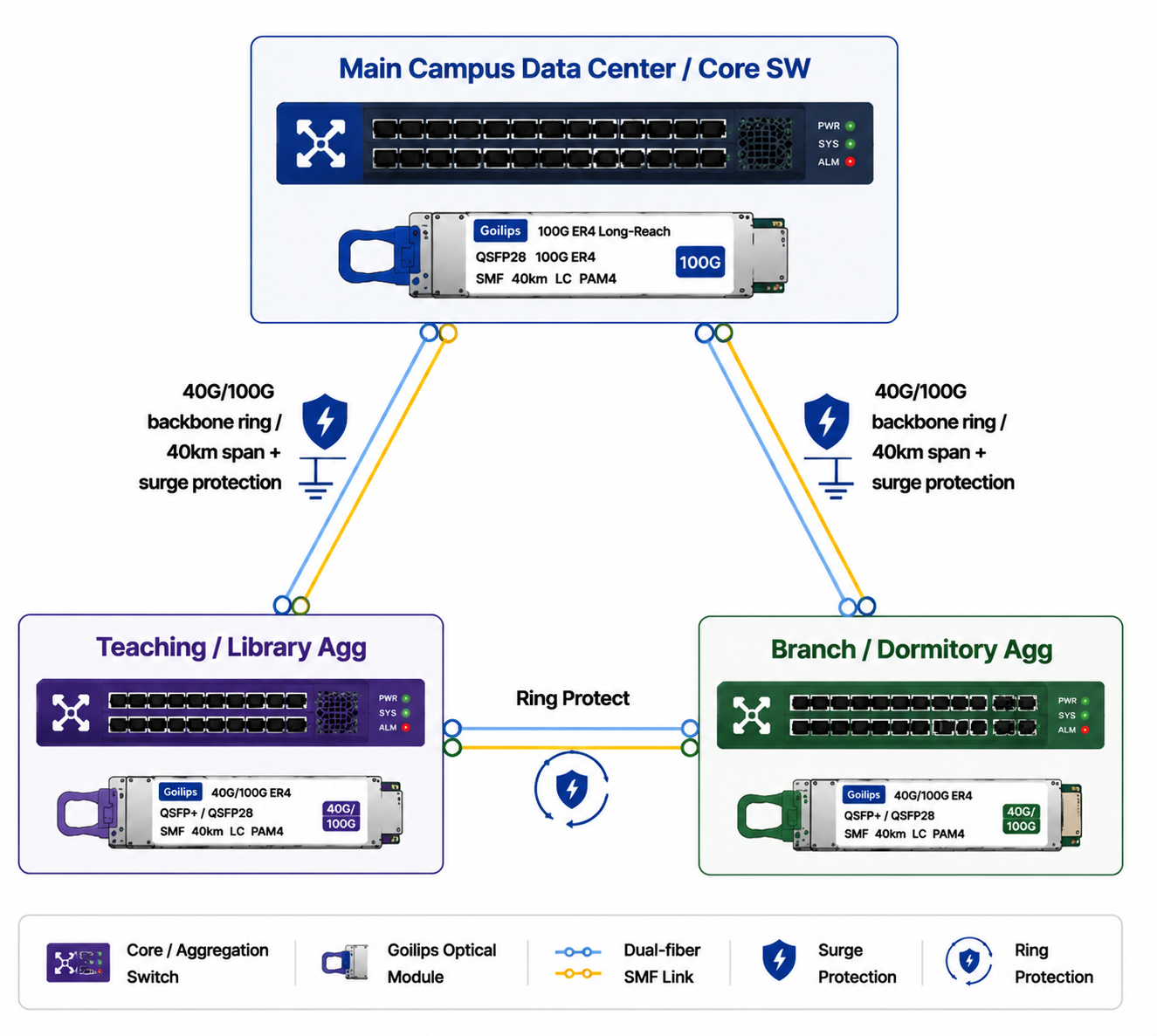
Core Deployment:Goilips 100G QSFP28 ER4 using 1310nm LAN-WDM four-wavelength transmission in QSFP28 form factor.
Advantage:Supports 40km spans with built-in APD high-sensitivity receiver and advanced hardware surge protection.
Core Deployment:Goilips 40G QSFP+ ER4 using 1310nm CWDM transmission in QSFP+ form factor.
Advantage:Provides 40km reach with industrial-grade durable housing, surge resistance, and overload protection.
Core Deployment:Matches Ethernet ring protection protocols such as ERPS G.8032, RRPP, and STP.
Advantage:Works with microsecond-level LOS detection to switch traffic to backup paths within 50ms after fiber cuts.
Core Deployment:Uses enhanced thermal structures and industrial-grade components for unconditioned rooftop or floor telecom rooms.
Advantage:Supports long-term operation at -20°C to +70°C extended temperature or -40°C to +85°C industrial temperature.
Dual-active ring architecture, millisecond self-healing, and lightning protection remove single points of failure and protect core campus services during severe weather or fiber cuts.
Reduces large-scale outages caused by lightning or surge damage to core ports and can cut emergency on-site repair incidents by more than 80%.
Standard QSFP+/QSFP28 interfaces are compatible with mainstream campus network equipment from Cisco, Huawei, H3C, Ruijie, and others, supporting current upgrades and future bandwidth growth.
Simplify your network deployment and reduce complexity. Connect with our engineers for a solution design tailored to your project.
Expert customer service on call, 5x24 phone support.
For general questions, email us anytime.
Our live agent is ready to chat and help in real time.