Securities trading, high-frequency quantitative investment, and core data center backup for banks.
In securities trading, futures high-frequency quantitative trading (HFT), and banking core data exchange, latency is cost and speed is revenue. Even a few hundred nanoseconds of network advantage can directly affect strategy returns and order matching success.
Traditional Ethernet optical modules focus mainly on throughput and bit error rate (BER). Retiming, electrical-optical and optical-electrical conversion, and signal shaping inside DSP/CDR chips can introduce non-negligible latency, often from several microseconds to tens of microseconds.
This solution uses Goilips financial-grade customized 10G/25G/100G ultra-low-latency optical modules. Through full-stack hardware optimization across physical chips, circuit design, and optical packaging, module internal transmission latency is compressed to the sub-microsecond level, building extremely agile, secure, and stable trading physical channels for financial institutions.
For quant funds, securities proprietary trading desks, and futures companies deploying trading gateways, market-data reception, and ultra-fast order channels in exchange colocation rooms.
For low-latency optical direct links between exchanges and securities data centers in financial hubs such as Shanghai, Shenzhen, and Beijing.
For same-city active-active or multi-active data centers requiring high-throughput, microsecond-level data synchronization and real-time accounting verification.
Between exchange matching engines, low-latency trading gateways, quant servers, and low-latency switches such as Arista, Cisco Nexus, and Exablaze, Goilips financial-grade ultra-low-latency optical modules are deployed across the full path to deliver physical-layer zero-wait transmission.
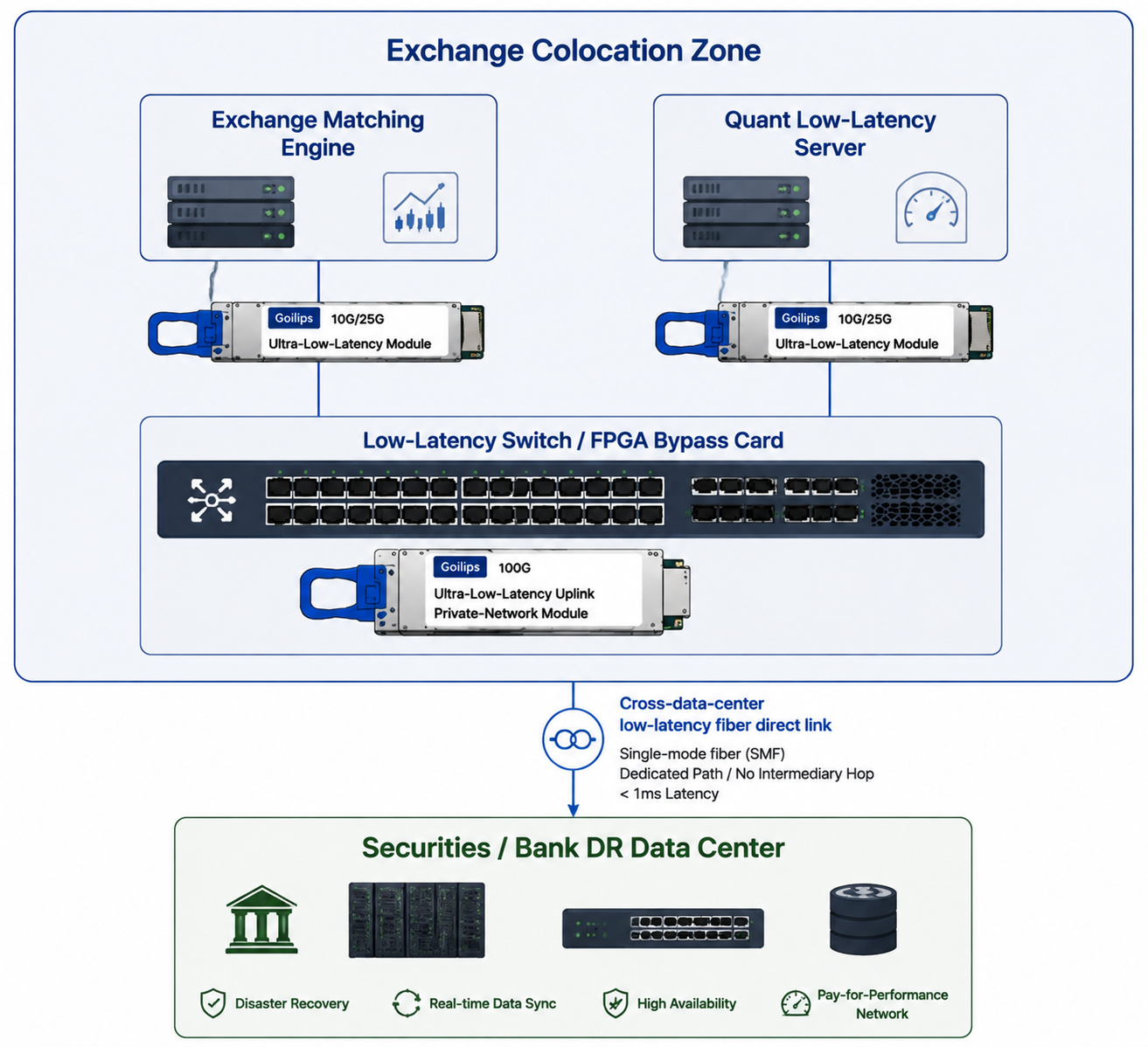
Core Deployment:Goilips 10G/25G ULL-SR modules in SFP+/SFP28 form factors for market-data and order-entry direct links.
Advantage:Typical physical latency below 1.5 ns, suitable for FPGA NICs and low-latency adapters such as Solarflare.
Core Deployment:Goilips 25G ULL-LR SFP28 modules for high-density in-rack interconnects.
Advantage:Typical physical latency below 2.0 ns, matching low-latency Ethernet switch fabrics.
Core Deployment:Goilips 100G ULL-DR4/FR4 QSFP28 modules for same-city cross-data-center private-network uplinks.
Advantage:Typical physical latency below 5.0 ns, suitable for core routers and private-network DWDM transmission equipment.
Core Deployment:Uses hardware cut-through or CDR-free analog direct-drive design instead of latency-heavy retiming and DSP buffering.
Advantage:Eliminates packet queuing and resampling processes, reducing module internal latency by more than 80%.
Reduces end-to-end latency by tens to hundreds of nanoseconds, helping quant funds and brokers gain critical timing advantages in microsecond-level trading competition.
Financial-grade component selection delivers strong jitter resistance and thermal stability, maintaining zero-stall and zero-packet-loss operation during opening-bell traffic bursts.
Standard SFP+/SFP28/QSFP28 interfaces allow financial institutions to optimize latency without changing network architecture or replacing core switching equipment.
Simplify your network deployment and reduce complexity. Connect with our engineers for a solution design tailored to your project.
Expert customer service on call, 5x24 phone support.
For general questions, email us anytime.
Our live agent is ready to chat and help in real time.