Cisco and NVIDIA Propose 12.8T USFP Optics for AI Fabrics
A proposed ultra-dense pluggable format targets 400G electrical lanes, 12.8T modules and higher front-panel bandwidth density for future AI fabrics.
What was announced
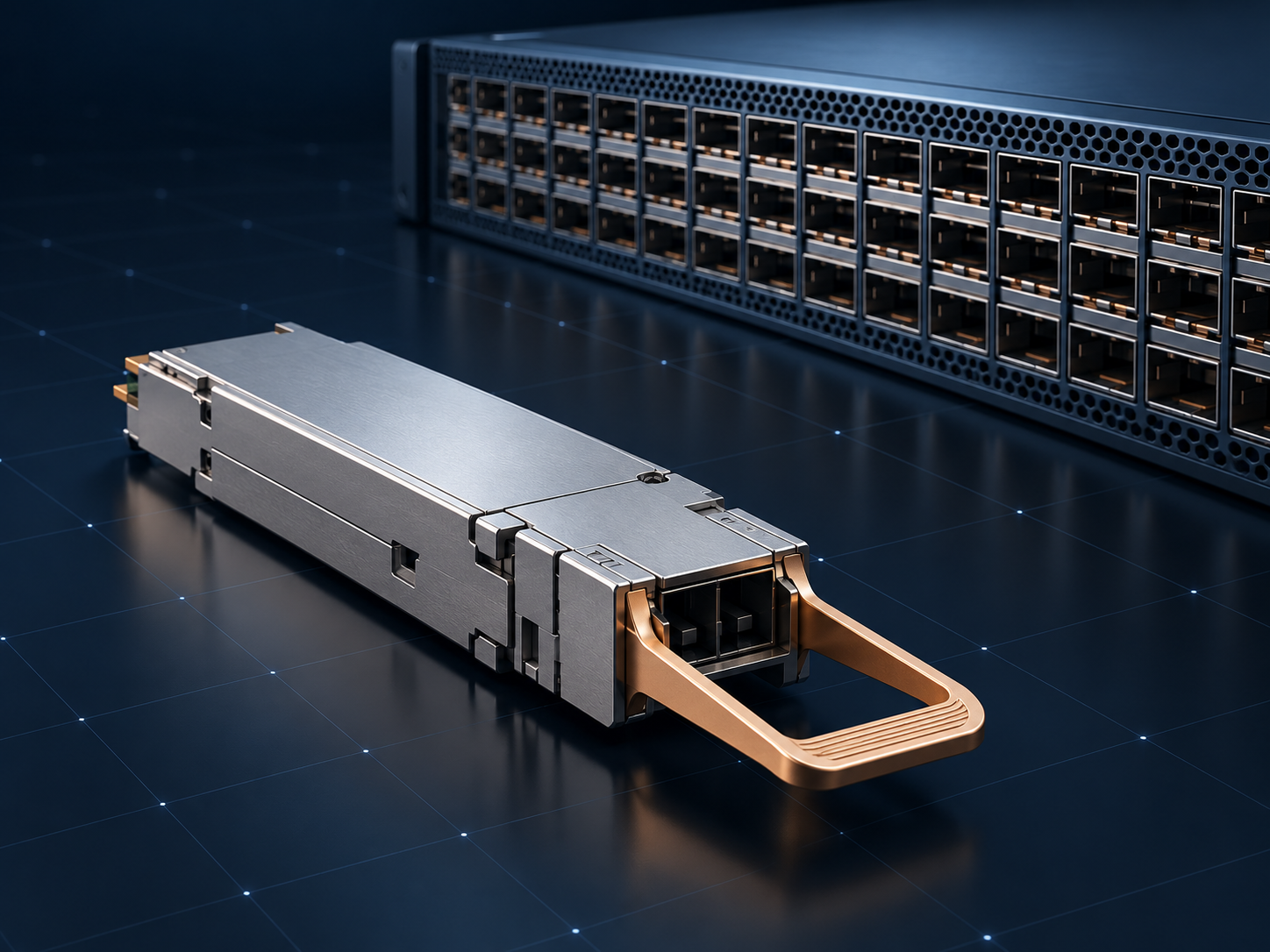
Cisco and NVIDIA introduced a proposed Ultra-Dense Small Form Factor Pluggable, or USFP, at the 2026 OCP Global Summit. The first design target is 400 Gb/s per electrical lane and as much as 12.8 Tb/s from one module. The companies say the concept could provide four times the bandwidth density and about 1.3 times the power efficiency of 200G-per-lane optics. TE Connectivity and Amphenol are participating in work on a multi-source hardware ecosystem.
The announcement matters because optical-network economics are decided by the surrounding system, not by a headline bit rate. Buyers need to translate the claimed capability into ports per rack unit, watts per transported bit, fiber count, operational complexity and usable capacity after overhead. They should also separate a demonstration, a proposed specification and a generally available product. Each carries a different level of technical and supply-chain risk.
For suppliers, the opportunity extends beyond the named module. It includes lasers, drivers, receivers, DSPs, connectors, fiber assemblies, thermal components, test instruments and manufacturing automation. The strongest commercial position will belong to vendors that can document yield, reliability, interoperability and change control. A novel architecture can create demand, but operators generally qualify complete links and service procedures before committing volume.
Technical significance and limits
USFP is an architectural proposal rather than a shipping interoperability standard. Its value depends on connector integrity at 400G per lane, thermal extraction, module control, optical reach and a sufficiently broad supplier base. Higher faceplate density can reduce the number of cages and fibers needed for a given switch capacity, but it also concentrates heat and makes signal-loss budgets more difficult. The format should therefore be compared with OSFP, co-packaged optics and the emerging XPO ecosystem at the complete system level, not by module bandwidth alone.
The reported figures should be read in their stated test context. Performance can change with host design, software, fiber plant and operating temperature. Independent interoperability and long-duration results will be more informative than a single peak measurement.
Deployment and commercial implications
Deployment teams should begin with a written link and platform budget. That document should identify electrical lane rates, optical reach, connector loss, FEC ownership, traffic assumptions, environmental limits and failure behavior. Tests should include cold start, repeated restart, alarm reporting, firmware upgrade, adjacent-port loading and sustained traffic at the highest expected inlet temperature. These checks often reveal constraints that a short exhibition demonstration cannot show.
Procurement should request a qualified-vendor list, availability schedule, warranty, field-replacement process and notice periods for component changes. A second source is meaningful only when it has passed the same host, optical and thermal tests. Operators should also model migration: early deployments may serve only the most demanding AI, transport or access locations, while existing interfaces remain economical elsewhere.
Capacity planning should use realistic traffic distributions instead of assuming every port runs at its nominal maximum continuously. Engineers need to test oversubscription, burst behavior, congestion recovery and the effect of failed links on neighboring paths. They should also include the upstream switch or transport layer in the calculation. A faster optical interface creates little customer value when backplane capacity, packet buffers or aggregation links remain the bottleneck. Energy analysis should include host SerDes, retimers, cooling and power conversion, not only the number printed on a module data sheet.
Operations teams need monitoring that exposes optical power, temperature, error counters and FEC margin in the tools they already use. Clear alarm thresholds and trend data make it possible to replace marginal components before a service failure. Documentation should define cleaning, inspection and spare-handling procedures because connector contamination can erase the margin promised by a new optical design. Security and software lifecycle also matter: module firmware, management interfaces and upgrade rollback should be included in acceptance tests, especially when optics become a more active part of the system.
A phased introduction gives buyers better evidence and limits operational risk. A useful sequence is laboratory qualification, a small field trial, one production cluster and then broader deployment after seasonal temperature and maintenance events have been observed. At each gate, teams should record error margin, power, repair time and software incidents against the original business case. This approach can reveal whether savings in space or capacity are being offset by specialized spares, training or cooling. It also gives suppliers measurable acceptance criteria instead of relying on broad claims about readiness.
The broader signal is that bandwidth growth is pushing optics deeper into computing and networking systems. That creates room for differentiated components, but also raises the cost of qualification. Success will depend on whether the ecosystem converts laboratory performance into repeatable manufacturing, open management and predictable field operation. Until that evidence is available, forecasts should be treated as scenarios rather than committed shipment volumes.
Sources and editorial note
This article is based on the primary announcement and independent industry coverage. Goilips has rewritten and contextualized the information. Claims attributed to the companies have not been presented as independent certification; readers should verify current specifications and availability with the vendors.