New-generation green, low-carbon data centers using immersion or spray liquid cooling.
As AI large-model training clusters and high-performance computing (HPC) racks move beyond 40kW to 100kW+ per cabinet, traditional air cooling has reached its physical limits. Liquid cooling technologies such as immersion cooling, direct spray cooling, and cold-plate direct liquid cooling have become core infrastructure for next-generation green, low-carbon data centers.
Liquid-cooling environments create demanding physical and electrical requirements for optical interconnects. Traditional optical modules may suffer from liquid ingress, chemical corrosion, and optical-path refractive-index shifts when exposed to fluorinated fluids, synthetic oils, or spray cooling media. At the same time, DSP chips are a major heat source in traditional modules, often accounting for 40% to 50% of total module power.
This Goilips solution uses specially sealed, corrosion-resistant 100G/400G AOC cables and no-DSP LPO optical modules designed for immersion and spray-cooled environments, helping data centers approach extremely low PUE targets of 1.05 to 1.10.
For cabinets where servers and switches are immersed in electronic fluorinated fluids or hydrocarbon synthetic oils, requiring optical interfaces and cables with excellent anti-leakage and chemical-inertness characteristics.
For cooling systems where liquid media are sprayed directly onto high-heat chips and optical transceiver surfaces, requiring dynamic sealing, impact resistance, and corrosion resistance.
For ultra-high-density compute nodes with strict PUE limits below 1.15, providing low-latency and ultra-low-power optical network interconnects.
Inside and between liquid-cooled cabinets, Goilips recommends a layered, simplified optical interconnect architecture: high-density anti-leakage AOC for intra-cabinet and adjacent-cabinet links, and ultra-low-power LPO modules for short-reach server-to-TOR or Spine-side connectivity.
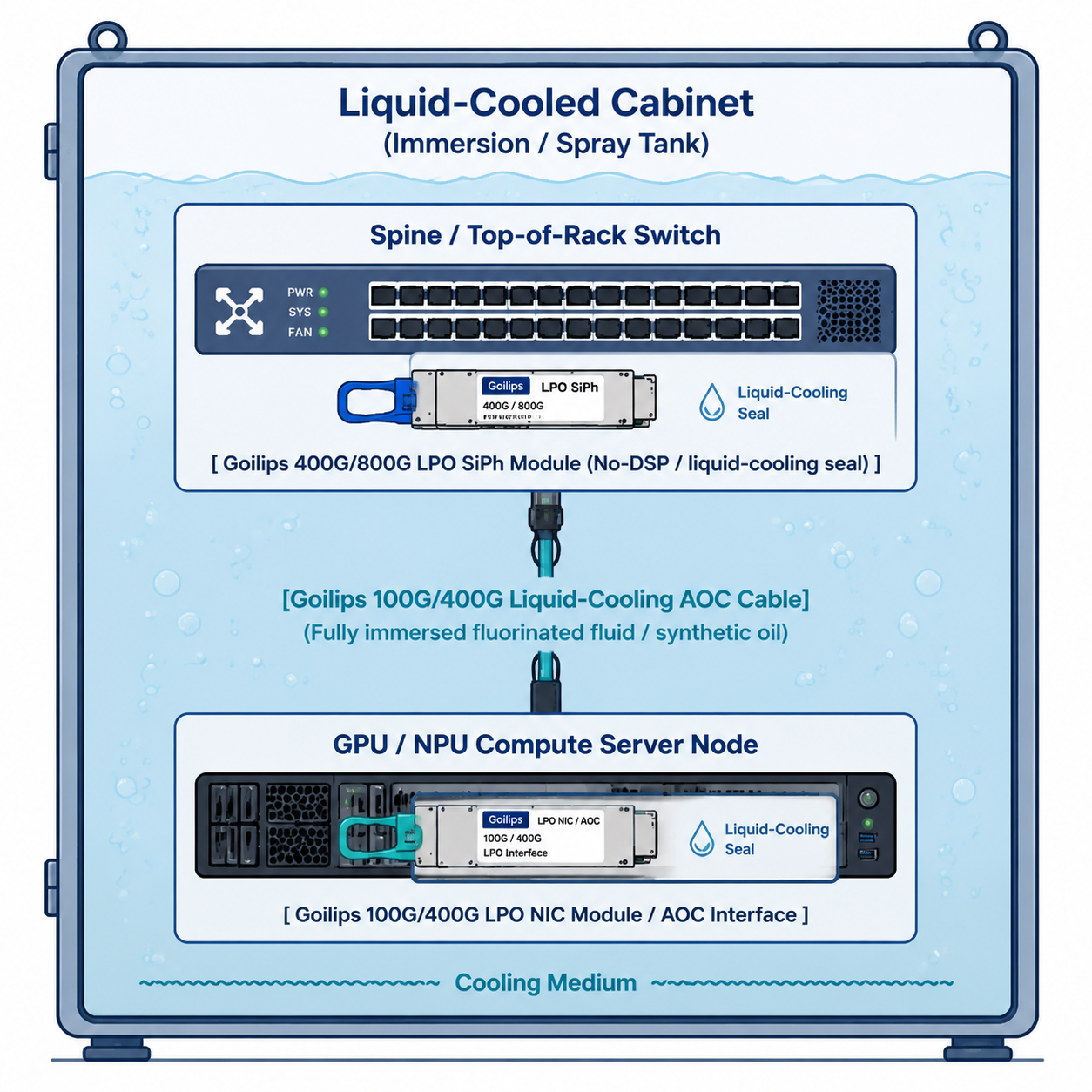
Core Deployment:Use FKM airtight sealing, laser-welded seams, and oil-/fluorinated-fluid-resistant fluoropolymer cable jackets.
Advantage:Prevents capillary ingress into the optical path, avoids optical attenuation, and reduces coolant contamination risk.
Core Deployment:Remove the internal DSP from traditional optical modules and use switch-side SerDes ASIC capability for linear drive and equalization.
Advantage:Cuts power by 40% to 50%, reduces latency close to zero, and substantially reduces local hot spots inside the cabinet.
Core Deployment:Optimize laser wavelength drift and lens assembly processes for stable 35°C to 50°C liquid-cooling temperature fields.
Advantage:Reduces BER risk caused by refractive-index changes in liquid environments and preserves optical coupling efficiency.
Core Deployment:Add flow-guiding grooves and high-conductivity micro-fin surfaces to module housings.
Advantage:Improves liquid heat exchange efficiency and keeps optical devices structurally stable under long-term fluid flow impact.
LPO reduces optical interconnect power to roughly half that of traditional modules, with 400G LPO power below 5W per port, easing the load on liquid-cooling circulation systems.
Removing high-temperature DSP heat sources lowers the internal operating temperature of optical components. Combined with IP68-class liquid-cooling sealing, this significantly reduces failure rates and improves MTBF.
The LPO architecture removes DSP encoding/decoding and FEC latency, reducing delay to the picosecond/nanosecond level and improving distributed training scaling efficiency.
Simplify your network deployment and reduce complexity. Connect with our engineers for a solution design tailored to your project.
Expert customer service on call, 5x24 phone support.
For general questions, email us anytime.
Our live agent is ready to chat and help in real time.