What Is an Optical Transceiver MSA? Multi-Source Agreements Explained
How optical transceiver MSAs define shared interfaces, encourage multi-vendor supply and differ from formal standards and guaranteed interoperability.
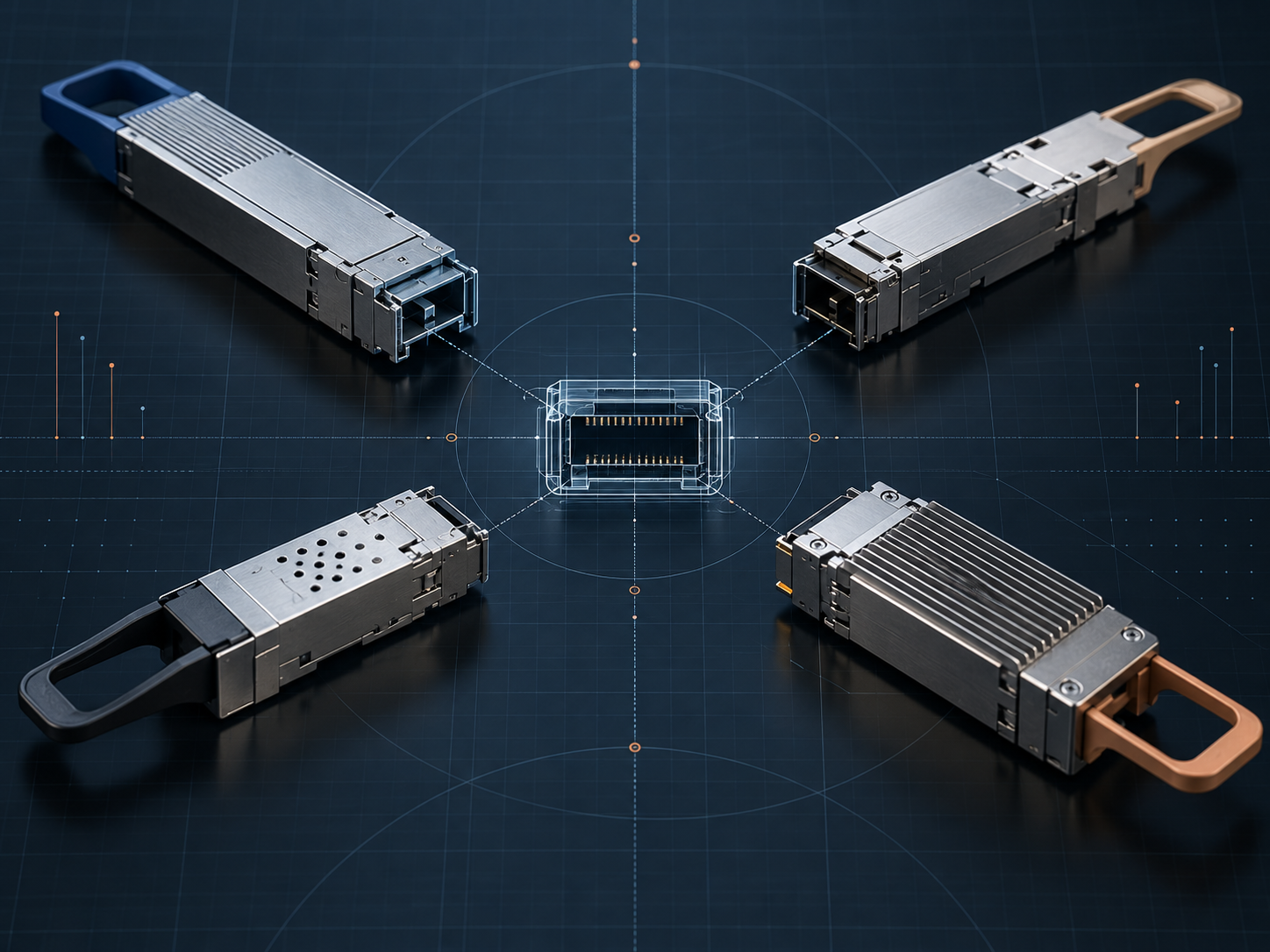
What an MSA means in optical networking
MSA stands for Multi-Source Agreement. In optical communications, it is an industry agreement under which participating companies publish a common interface so that more than one supplier can design modules, connectors or related components for the same equipment ecosystem. The two reference articles from NADDOD and FS describe how MSAs helped optical transceivers move from proprietary designs toward repeatable form factors and wider supplier choice. That role becomes more important as networks migrate through 100G, 400G, 800G and 1.6T generations, because a switch platform may remain in service longer than any single optics contract.
An MSA is not necessarily a formal standard issued by IEEE, ITU-T or another accredited standards body. It is normally created by a group of companies responding to a practical market requirement. Its specification may define module dimensions, cage and connector geometry, host electrical lanes, control pins, power classes, thermal behavior, memory maps and management commands. Some MSAs focus on a physical form factor, while others define an optical interface such as wavelength, lane count, transmitter power, receiver sensitivity and reach. The exact scope must be read rather than inferred from the MSA name.
The original SFP agreement is a useful example. INF-8074i describes the SFP mechanical and electrical interface, while later SFF documents cover identification and digital diagnostics. More recent groups created formats such as QSFP-DD and OSFP or optical specifications such as CWDM4, PSM4 and 100G Lambda. Together, these agreements let equipment manufacturers, module vendors, connector makers and test suppliers work against a shared technical boundary before one vertically integrated supplier controls the entire link.
How MSAs create commercial value
The first benefit is supply competition. If several manufacturers implement the same published interface, buyers can qualify alternatives instead of redesigning a line card whenever a supplier changes. That can improve price transparency, reduce dependence on one factory and provide a recovery path during shortages. It can also shorten product development because cage, connector, heat-sink, firmware and test-tool suppliers can build around the same drawings and management model.
The second benefit is faster market formation. Formal standards work is designed for broad consensus and long-term stability, but the industry sometimes needs an interface before that process is complete. An MSA can align early adopters around a sufficiently detailed implementation and provide real hardware experience. Successful ideas may later coexist with, contribute to or be superseded by standards from IEEE, ITU-T, OIF or SNIA. The 100G Lambda MSA, for example, published single-wavelength 100G optical specifications to support higher aggregate rates, while the QSFP-DD MSA defined an eight-lane high-density module family and its mechanical, electrical, thermal and management relationships.
For suppliers, participation offers early visibility into interface assumptions and lets engineering teams influence manufacturability, thermal limits and interoperability. For operators, the benefit is not simply a cheaper optic. A healthy multi-source ecosystem can improve spare availability, lifecycle support and negotiation leverage. The commercial value is strongest when specifications are public, revision control is clear, conformance can be measured and several independent products have completed interoperability testing.
What MSA compliance does not guarantee
The phrase “MSA compliant” should not be treated as a universal compatibility certificate. Two modules may share a form factor yet implement different Ethernet PMDs, wavelengths, fiber types, connectors or reaches. A module may fit mechanically but exceed the host power limit, require a different FEC mode or use management features that the installed firmware does not understand. Some network equipment vendors also apply EEPROM coding, approved-vendor lists or support policies beyond the physical specification.
Nor does an MSA guarantee identical performance. Receiver margin, transmitter quality, thermal stability, component lifetime, diagnostic accuracy and manufacturing control can vary between vendors while each product remains inside the same published limits. Interoperability should therefore be tested as a complete link, including the host SerDes, module firmware, fiber plant, patching, FEC and operating temperature. Buyers should distinguish specification conformance, host qualification and optical interoperability; these are related but separate gates.
Revision numbers matter as well. Fast-moving form factors add new lane rates, power classes and cooling provisions over time. The current QSFP-DD family, for instance, spans several electrical generations, and backward compatibility depends on the particular cage, connector and host design. A purchase specification should name the required document and revision, not merely say “QSFP-DD MSA” or “SFP MSA.” It should also define which diagnostics, alarms, firmware behaviors and breakout modes are required in production.
A practical qualification checklist
Start by separating three layers. First, confirm the mechanical form factor, cage, connector and heat-removal method. Second, confirm the host electrical interface: lane count, lane rate, modulation, equalization, FEC responsibility, control signals and management specification. Third, confirm the optical PMD: wavelength plan, fiber type, connector, reach, link budget and environmental range. A match in one layer does not prove a match in the other two.
Procurement teams should request the exact MSA revision, host qualification list, interoperability report, power class, operating-temperature range and change-notification policy. Laboratory testing should cover cold and warm start, repeated insertion, full neighboring-port population, realistic airflow, digital diagnostics, alarm thresholds and sustained traffic. Multi-vendor links should be tested in both directions and with the firmware intended for deployment. Contracts should identify responsibility for fault isolation when the switch, module and fiber assembly come from different suppliers.
Sources: NADDOD: Introduction to Optical Transceiver MSA Standards; FS: How Much Do You Know About MSA Standard?; INF-8074i SFP specification; QSFP-DD Hardware Rev 7.1; and 100G Lambda MSA specification. Goilips combined the two explanatory articles with primary specifications and added independent deployment guidance.