difference between SFP-DD,DSFP and QSFP28
A practical comparison of the two-lane SFP-DD and DSFP formats with the mature four-lane QSFP28 ecosystem, covering compatibility, density and deployment choices.
The short answer
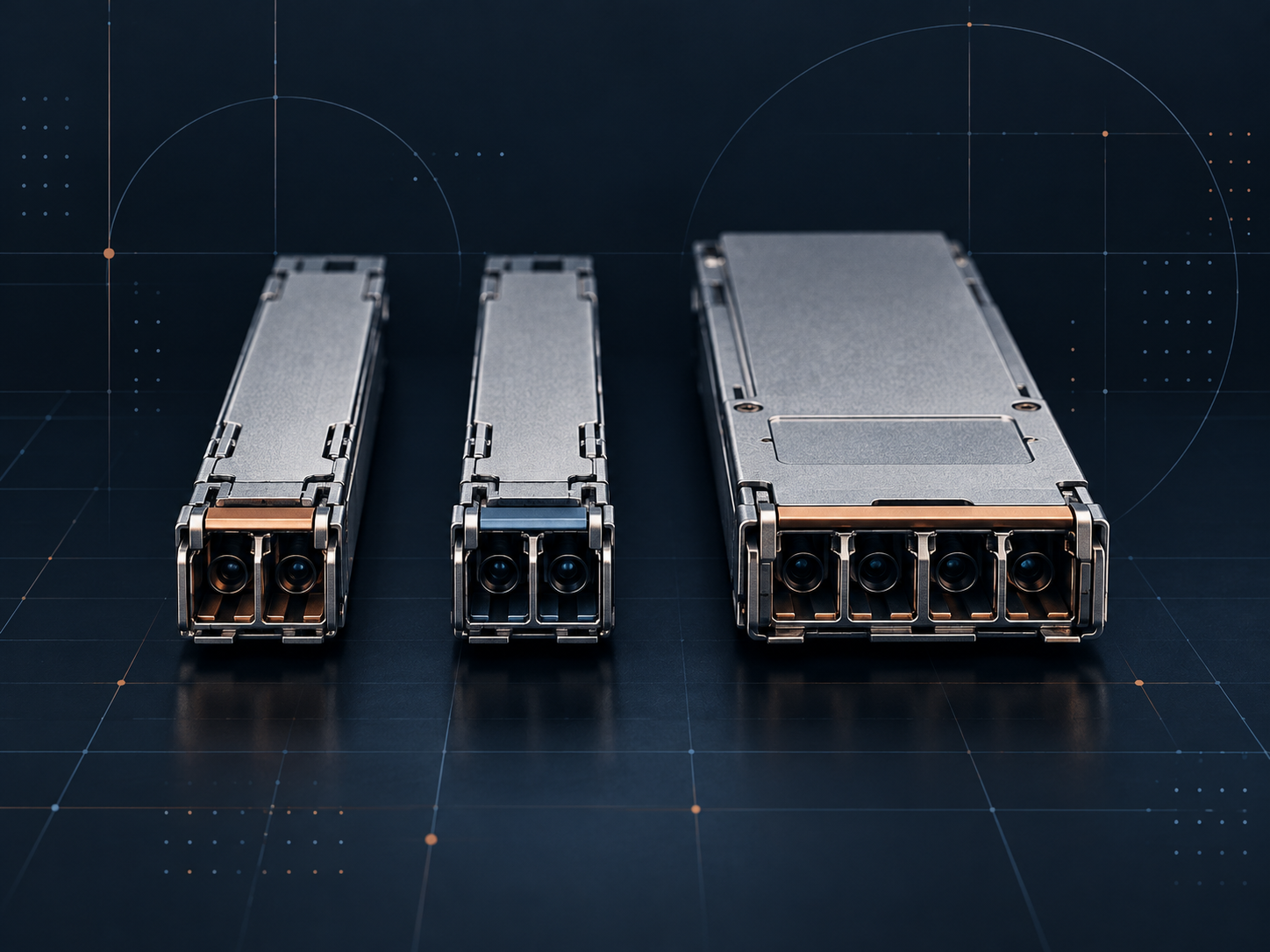
SFP-DD, DSFP and QSFP28 are pluggable transceiver form factors, not optical-reach standards. The simplest distinction is lane count and mechanical ecosystem. SFP-DD and DSFP are both narrow, double-lane concepts derived from the SFP footprint, while QSFP28 is a wider four-lane format that became the mainstream choice for 100 Gigabit Ethernet. A typical 100G QSFP28 module combines four 25 Gb/s electrical lanes. A 100G SFP-DD or DSFP design can instead combine two 50 Gb/s PAM4 lanes, allowing more front-panel ports when the host platform is built for that connector.
The names do not guarantee that two modules will mate, initialize or carry the same protocol. SFP-DD and DSFP were created by different multi-source agreements and use different connector, cage and management definitions. They should therefore be treated as separate ecosystems. QSFP28 is physically wider and has four lanes, so it is not a drop-in replacement for either narrow format. Optical specifications such as SR4, DR, FR, LR or CWDM4 remain separate decisions covering wavelength plan, fiber type, connector and reach.
At a glance: SFP-DD offers two lanes plus a defined path for accepting many legacy SFP-family modules in an SFP-DD cage; DSFP also provides two lanes in an SFP-width package but follows its own MSA and an abbreviated CMIS management model; QSFP28 provides four lanes, a very mature 100G supply chain and broad switch support. The right choice depends first on the host cage and SerDes architecture, then on the required optical interface.
Mechanical, electrical and management differences
The SFP-DD hardware specification keeps the original 20 SFP contacts and adds a second 20-contact row. Its host connector exposes two high-speed channels that may operate as a two-lane trunk or as two independent single-lane applications. The specification also states that the cage and socket can accept SFP modules from SFP10 onward; in that case only one lane is used. This backward-compatible physical path is attractive for equipment vendors that want to mix lower-speed SFP-family ports with new double-density links. It does not remove the need to verify host firmware, electrical signaling, power class, cooling and protocol support.
DSFP means Dual Small Form Factor Pluggable. Its specification defines two electrical lanes and a latch compatible with SFP+, while planning electrical and mechanical capability for higher-speed interfaces. DSFP management is based on an abbreviated version of CMIS. Despite the similar width and two-lane objective, a DSFP module should not be inserted into an SFP-DD port unless the equipment vendor explicitly documents support. Small differences in card-edge contacts, cage geometry, pin assignment and control behavior are enough to prevent safe interoperability.
QSFP28 belongs to the four-lane QSFP family covered by the SFF-8665 physical and low-speed interface specification. In conventional 100G equipment, it normally presents four 25 Gb/s NRZ electrical lanes. Its wider body offers more surface area for components and heat transfer, while one module delivers the aggregate bandwidth that would require two 50G-class ports in a two-lane architecture. Management on deployed QSFP28 platforms commonly follows SFF-8636. Breakout behavior, however, depends on the switch ASIC, firmware and the module or cable; four physical lanes do not automatically mean every port supports four independent services.
Where each form factor fits
SFP-DD is useful when front-panel port count is the priority and the platform roadmap moves toward 50 Gb/s-per-lane signaling. Examples include compact access switches, dense aggregation systems and PON equipment in which a vendor wants more interfaces within one rack unit. Its ability to accept established SFP-family modules can simplify a mixed-speed chassis strategy. The trade-off is thermal density: placing more powered modules in the same width increases local heat flux, so neighboring-port population, airflow direction and maximum module power must be checked under worst-case inlet temperature.
DSFP addresses a similar density problem and can be appropriate when a selected platform, line card or access product was designed specifically around the DSFP MSA. Buyers should ask for an explicit qualified-module list because the ecosystem is less universal than QSFP28. A DSFP port may be technically elegant for a purpose-built design, but a smaller supplier pool can affect second sourcing, field spares and long-term availability. The value is strongest when the equipment vendor can demonstrate stable interoperability rather than relying only on the shared “dual-lane SFP” description.
QSFP28 remains the practical default for many 100G data-center, telecom and enterprise links. It is supported by a large base of switches, routers, network interface cards, test equipment, passive and active copper cables, and optical modules for multimode and single-mode fiber. That maturity usually makes qualification and replacement easier. It does not mean every QSFP28 module works in every host: coding, FEC, wavelength, connector, maximum power, vendor policy and software still need alignment. For new platforms seeking maximum faceplate density at newer lane rates, a double-density SFP design can be attractive; for established 100G networks, QSFP28 often minimizes integration risk.
Selection checklist and sources
Start with the equipment data sheet rather than the module label. Confirm the exact cage type, supported electrical lane rate, modulation, Ethernet or transport protocol, FEC responsibility, management specification and maximum power class. Then choose the optical PMD, wavelength, reach, fiber and connector. Validate cold start, warm restart, digital diagnostics, alarm thresholds and firmware behavior. A production test should populate adjacent ports, use realistic airflow and traffic, and measure temperature and error margin over the required environmental range.
Procurement teams should also compare qualified vendors, lead time, warranty terms, change-control notices and spare strategy. If backward compatibility or breakout is important, require the host manufacturer to name the supported combinations instead of inferring them from the connector family. In short, select SFP-DD for an SFP-compatible double-density roadmap, DSFP for equipment expressly built around the DSFP ecosystem, and QSFP28 for a mature four-lane 100G environment. The form factor narrows the choices; it does not finish the link design.
Primary references: SFP-DD Hardware Specification Rev 4.2; DSFP MSA Hardware Specification Rev 1.0; and SNIA SFF-8665 Rev 2.0. Goilips has summarized the specifications and added deployment guidance; verify the current host and module documentation before purchase.